
Sculptra (poly-L-lactic acid, or PLLA) and Radiesse (calcium hydroxylapatite, or CaHA) are both FDA-cleared biostimulators that trigger collagen remodeling, but they work through fundamentally different mechanisms and produce distinct timelines and longevity profiles. Understanding those differences is essential for patient selection, revenue modeling, and managing expectations.
Injectables
Sculptra vs Radiesse: Mechanism, Timeline, and Clinical Use Cases for Medspa Owners
Two FDA-cleared biostimulators with distinct mechanisms and patient outcomes—how to choose between PLLA and CaHA for your practice.
| Compared | Sculptra | Radiesse |
|---|---|---|
| Active ingredient | Poly-L-lactic acid (PLLA) microparticles | Calcium hydroxylapatite (CaHA) microspheres in CMC gel |
| Mechanism | Triggers foreign-body response; fibroblasts deposit collagen around particles over time | Immediate volume from gel carrier; CaHA stimulates fibroblast collagen deposition |
| Onset of results | 4–6 weeks; full results at 6 months post-final injection | Visible within days; continues improving over weeks and months |
| Treatment sessions | 3–4 sessions spaced 4–6 weeks apart | Often 1 session; 2–3 for larger deficits |
| Typical duration | 2–3 years, sometimes longer | 12–18 months, sometimes longer in low-movement areas |
| Best for | Large-volume facial loss, gluteal augmentation, body contouring; patients with realistic timelines | Immediate results, nasolabial folds, marionette lines, hands; single-session preference |
| Patient expectation | Slow-build, cumulative; requires patience and commitment | Instant gratification with ongoing improvement |
| Downtime | Minimal; bruising and swelling possible | Minimal; bruising and swelling possible |
| FDA status | Cleared for facial lipoatrophy (HIV); widely used off-label for age-related volume loss | Cleared for nasolabial folds and facial wrinkles; used off-label for hands and body |
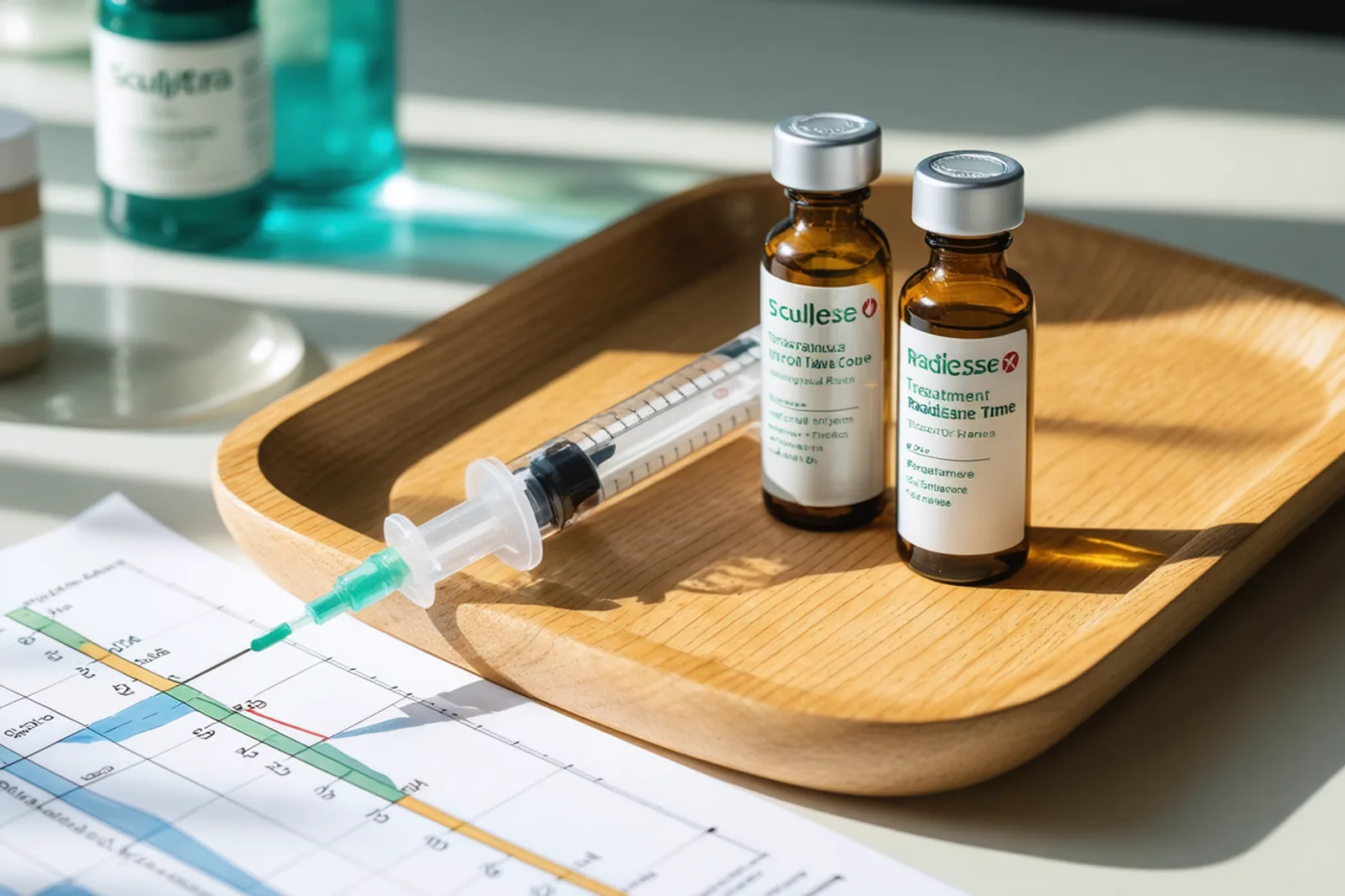
Sculptra requires 3–4 sessions and 6 months for full results; Radiesse shows visible lift within days but lasts 12–18 months—different timelines, different patient profiles.
Sculptra is a microparticle suspension of PLLA, a synthetic polymer that has been used in medical devices for decades. When injected into the dermis, PLLA particles remain in place and trigger a foreign-body inflammatory response that recruits macrophages and fibroblasts. Over months, those cells lay down new collagen around the particles. The PLLA itself is gradually absorbed and metabolized; the collagen remains. The process is slow and cumulative—results depend on the body's own synthesis, not immediate filler volume.
Radiesse is a calcium hydroxylapatite (CaHA) microsphere suspension in a carboxymethylcellulose (CMC) gel carrier. CaHA is the same mineral that comprises bone. The gel carrier provides immediate volume and structure, while the CaHA particles stimulate fibroblast activity and collagen deposition. Radiesse also offers a dual benefit: immediate lift from the gel, plus biostimulation from the particles. The CaHA is gradually replaced by the body's own collagen over 12–18 months.
Results Timeline and Patient Expectations
Sculptra requires patience. Results are not visible for 4–6 weeks; meaningful improvement typically takes 8–12 weeks and may require 3–4 treatment sessions spaced 4–6 weeks apart. The cumulative effect is the point—each session adds volume and stimulation. Full results plateau around 6 months post-final injection. Longevity is substantial: 2–3 years is typical, sometimes longer. Patients must understand upfront that this is a slow-build strategy; those seeking immediate gratification will be disappointed.
Radiesse delivers faster feedback. The CMC gel provides visible lift within days; patients see a result immediately. Biostimulation continues over weeks and months, so the appearance improves further. A single session often produces satisfactory results, though some practitioners use 2–3 sessions for larger volume deficits. Results are durable for 12–18 months, sometimes longer in lower-movement zones.
Clinical Use Cases
Sculptra excels in:
- Large-volume facial loss (cheeks, temples, jawline definition) where gradual, natural-looking restoration is the goal
- Patients with realistic timelines who can commit to multiple sessions
- Gluteal augmentation and body contouring (off-label but widely used; Sculptra Aesthetic is FDA-cleared for facial lipoatrophy in HIV patients, but the mechanism applies to age-related volume loss)
- Practices seeking high patient lifetime value and repeat-visit revenue
Radiesse is better suited for:
- Patients who want visible results immediately
- Nasolabial folds, marionette lines, and hand rejuvenation (areas where immediate structure matters)
- Single-session treatments or those with limited follow-up capacity
- Combination therapy with neuromodulators (Radiesse provides structure; botulinum toxin manages dynamic lines above)
Economics and Practice Considerations
Sculptra is typically priced per vial ($600–$900 per vial wholesale; retail $1,200–$1,800). A full facial course often requires 3–4 vials, creating a $3,600–$7,200 patient spend over 4–6 months. Radiesse is priced per syringe ($400–$600 wholesale; retail $800–$1,200 per syringe). Most patients need 1–2 syringes per session, yielding $800–$2,400 per visit.
From a cash-flow standpoint, Radiesse front-loads revenue; Sculptra spreads it across multiple visits. Both drive repeat business—Sculptra through mandatory sequencing, Radiesse through durability and patient satisfaction with immediate results.
Manufacturer loyalty programs (Allergan Aesthetics for Sculptra; Galderma for Radiesse) offer rebates and volume incentives. Verify current terms with your account manager, as these shift seasonally.
Injection Technique and Depth
Sculptra is injected into the deep dermis or subcutaneous layer, often via threading or fanning techniques to distribute particles evenly. Superficial placement risks nodule formation—a known complication if technique is poor. Proper reconstitution (typically 24 hours before injection) and adequate dilution are critical.
Radiesse can be placed in the mid-to-deep dermis or subcutaneous layer depending on the target. Its immediate volume means placement is more forgiving; the CMC carrier provides cushioning and reduces nodule risk compared to Sculptra.
Bottom Line
Choose Sculptra for patients seeking maximum volume restoration over time and willing to commit to a protocol. Choose Radiesse for those wanting immediate results and shorter treatment windows. Many practices stock both and use them complementarily—Radiesse for quick wins, Sculptra for deeper, longer-term rejuvenation. Understanding the mechanism and timeline prevents patient dissatisfaction and optimizes your treatment mix.
Frequently asked questions
How long does it take to see results from Sculptra vs Radiesse?
Sculptra results appear gradually over 4–6 weeks with full results at 6 months, requiring 3–4 sessions spaced 4–6 weeks apart. Radiesse delivers visible lift within days from the CMC gel carrier, with continued biostimulation over weeks and months, often requiring only 1–2 sessions for satisfactory results.
What's the difference between PLLA and CaHA and how do they work?
Sculptra (PLLA) triggers a foreign-body inflammatory response that recruits fibroblasts to build new collagen around the microparticles over time, while the PLLA itself is gradually absorbed. Radiesse (CaHA) provides immediate volume from its gel carrier and simultaneously stimulates collagen deposition from the mineral particles, offering both instant lift and biostimulation.
How long do Sculptra and Radiesse results last?
Sculptra results typically last 2–3 years or longer, as the collagen remodeling is sustained even after the PLLA particles are absorbed. Radiesse results are durable for 12–18 months, sometimes longer in lower-movement areas like the hands.
Is Sculptra or Radiesse better for immediate results?
Radiesse is the clear choice for patients wanting immediate visible improvement, as the CMC gel provides instant lift and structure within days. Sculptra is a slow-build strategy best suited for patients with realistic timelines who understand results take 8–12 weeks and require multiple sessions.
What areas are Sculptra and Radiesse best used for?
Sculptra excels for large-volume facial loss (cheeks, temples, jawline) and body contouring where gradual restoration is desired. Radiesse is ideal for nasolabial folds, marionette lines, hand rejuvenation, and single-session treatments where immediate structural support is needed.
How many Sculptra vials does a patient need for full facial results?
A full facial Sculptra course typically requires 3–4 vials, with each vial costing $600–$900 wholesale and retailing for $1,200–$1,800, creating a total patient investment of $3,600–$7,200 for the complete treatment series.
Free weekly brief
Get the free weekly brief.
The week's most important moves in medical aesthetics — distilled to a two-minute read, free. Unsubscribe in one click.
Free · weekly · unsubscribe anytime. Privacy.
Stay three moves ahead of every practice in your market.
Knowing it happened is table stakes. Inside MedSpa Pro hands you the play — what each move means for your margins, your license, and your patients, and exactly what to do about it — in a two-minute brief every morning. The owners who read it never get blindsided.
Get the edge · $20/moJoin the owners who run ahead of the industry. Cancel anytime, one click.